71 エネルギー 【宇宙旅行】宇宙との対話
71-1 比較
・電子ニュートリノの質量:4.0*10^-19 J [1]
・陽子の質量:1.5*10^-8 J [2]
・ヒッグス粒子の質量:2.0*10^-8 J [3]
・地球表面で地表から1メートルの高さにあるリンゴ (102 g) が持つ位置エネルギー:1 J [4]
・脳の消費エネルギー:1.67*10^6 J/日
・質量1kgの物体が太陽系から脱出するために必要な運動エネルギー:1.9*10^11 J [4]
・人類史上最大の核兵器が爆発したときに発したエネルギー(ツァーリ・ボンバ、1961年):2.5*10^17 J [4]
71-2 ダイソン球:星のエネルギー利用 [4]
○アメリカの宇宙物理学者、フリーマン・ダイソンが1960年提唱した。
○恒星を卵の殻のように覆い、そのエネルギーのほとんどを利用する仮説上の人工構造物。
○ダイソン球を発見すれば、高度な文明を持つ宇宙人が存在することを確認できる。
○また、技術開発の方向を知ることが出来る。
○地球から1,480 光年離れた恒星KIC 8462852は、不自然な赤外線を発していることから、ダイソン球である可能性がある。[5][6] [7]
○なお、SETIの科学者がアレン・テレスコープ・アレイで1-10GHzの電波を調べたものの、人工的な信号を見出すことはできなかった。[8]
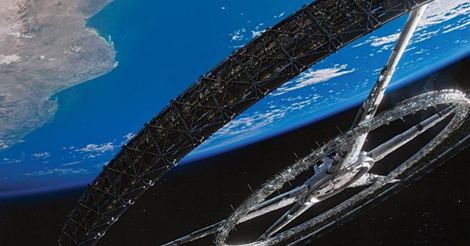
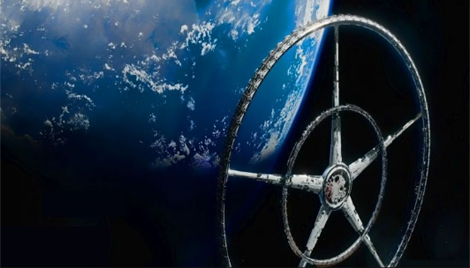
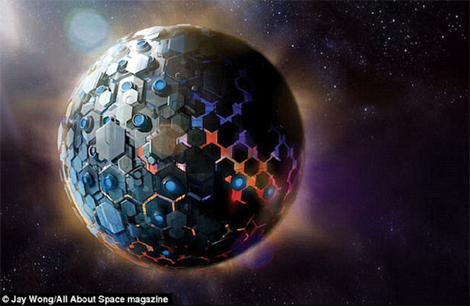 ※ダイソン球のイメージ[5]
71-3 エネルギーの利用レベル:カルダシェフ・スケール[8][9]
○ニコライ・カルダシェフは、高度に発達した宇宙文明を3つの段階に分けている。
第1段階 一つの惑星上で得られる全エネルギーを利用する文明≒4.0*10^12 J/s
第2段階 一つの恒星系で得られる全エネルギーを利用する文明≒4.0*10^26 J/s
第3段階 一つの銀河系で得られる全エネルギーを利用する文明≒4.0*10^37 J/s
○マイケル・ギャレットは、中赤外による地球外文明探索の結果、第3段階の文明は非常にまれか、存在しないと報告している。(2015年8月) [9]
○到達期間 [8]
第1段階 100~200年
第2段階 数千年
第3段階 10万~100万年
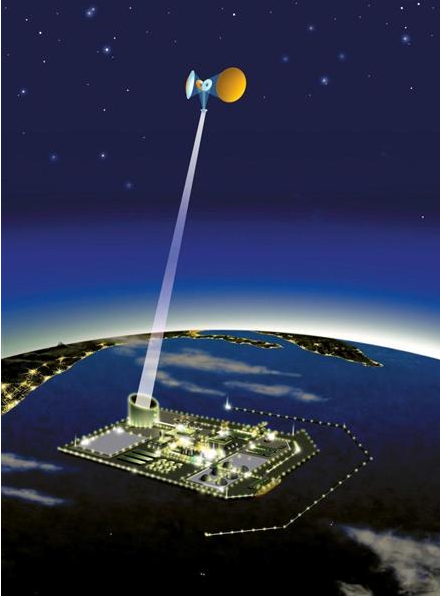
71-4 宇宙太陽光発電システム(SSPS:Space Solar Power Systems)[11]
○JAXAは2030年の商用化を目標にしている。
○要素技術
・宇宙空間に太陽光パネルを展開し、マイクロ波もしくはレーザーにより地上に送る。
※ただし、レーザーの場合は天候の影響を受ける。
※受信局は海上等に設置。
○コスト
・100万kw(原発1基分)の施設(2030年設置)の場合[11]
輸送費:5兆円
建設費:1.3~2兆円
維持管理費:340億円/年
※太陽光パネルは2km四方。
※発電コスト8円/kwhを達成するためには輸送費を今の50分の1にまで下げる必要がある。
※原発1基の建設費は数千億円だが、日本の場合、最終処分場はない。
※ダイソン球のイメージ[5]
71-3 エネルギーの利用レベル:カルダシェフ・スケール[8][9]
○ニコライ・カルダシェフは、高度に発達した宇宙文明を3つの段階に分けている。
第1段階 一つの惑星上で得られる全エネルギーを利用する文明≒4.0*10^12 J/s
第2段階 一つの恒星系で得られる全エネルギーを利用する文明≒4.0*10^26 J/s
第3段階 一つの銀河系で得られる全エネルギーを利用する文明≒4.0*10^37 J/s
○マイケル・ギャレットは、中赤外による地球外文明探索の結果、第3段階の文明は非常にまれか、存在しないと報告している。(2015年8月) [9]
○到達期間 [8]
第1段階 100~200年
第2段階 数千年
第3段階 10万~100万年
71-4 宇宙太陽光発電システム(SSPS:Space Solar Power Systems)[11]
○JAXAは2030年の商用化を目標にしている。
○要素技術
・宇宙空間に太陽光パネルを展開し、マイクロ波もしくはレーザーにより地上に送る。
※ただし、レーザーの場合は天候の影響を受ける。
※受信局は海上等に設置。
○コスト
・100万kw(原発1基分)の施設(2030年設置)の場合[11]
輸送費:5兆円
建設費:1.3~2兆円
維持管理費:340億円/年
※太陽光パネルは2km四方。
※発電コスト8円/kwhを達成するためには輸送費を今の50分の1にまで下げる必要がある。
※原発1基の建設費は数千億円だが、日本の場合、最終処分場はない。
 ○関連
・ソーラーセイル⇔No.66-5 恒星探査計画
【参 考】
1. Wikipedia:ニュートリノ
1. Wikipedia:ヒッグス粒子
2. Wikipedia:陽子
3. Wikipedia:ダイソン球
4. MARK PRIGG FOR DAILYMAIL.COM(October 2015)
http://www.dailymail.co.uk/sciencetech/article-3271546/Have-researchers-alien-MEGASTRUCTURE-Researchers-reveal-bizarre-star-say-huge-unknown-object-blocking-light.html
5. No.96 宇宙人との交信
6. Wikipedia:KIC8462852
7. “あのダイソン球と騒がれた星の謎がまた復活”at GIZMODO
http://www.gizmodo.jp/2016/08/kic-8462852-got-more-mysterious.html
8. Wikipedia:Kardashev scale
9. Wikipedia:宇宙太陽光発電
10. 産経ニュース”「馬鹿げた計画」酷評「宇宙太陽光発電」 NASAが手を引いても開発続ける「技術立国日本」の意地”2015年3月
http://www.sankei.com/premium/news/150327/prm1503270001-n3.html
○関連
・ソーラーセイル⇔No.66-5 恒星探査計画
【参 考】
1. Wikipedia:ニュートリノ
1. Wikipedia:ヒッグス粒子
2. Wikipedia:陽子
3. Wikipedia:ダイソン球
4. MARK PRIGG FOR DAILYMAIL.COM(October 2015)
http://www.dailymail.co.uk/sciencetech/article-3271546/Have-researchers-alien-MEGASTRUCTURE-Researchers-reveal-bizarre-star-say-huge-unknown-object-blocking-light.html
5. No.96 宇宙人との交信
6. Wikipedia:KIC8462852
7. “あのダイソン球と騒がれた星の謎がまた復活”at GIZMODO
http://www.gizmodo.jp/2016/08/kic-8462852-got-more-mysterious.html
8. Wikipedia:Kardashev scale
9. Wikipedia:宇宙太陽光発電
10. 産経ニュース”「馬鹿げた計画」酷評「宇宙太陽光発電」 NASAが手を引いても開発続ける「技術立国日本」の意地”2015年3月
http://www.sankei.com/premium/news/150327/prm1503270001-n3.html
70 The Cost of Space Travel【Space Travel】Dialogue with the Universe○Cargo [1]・・・< >:Success rate(%)・Falcon(SpaceX/USA) 1.6 billion$/t<79.2>・Proton(ILS/RUS) 1.7 billion$/t<88.2>・H2B(Mitsubishi Heavy Industries/JPN) 1.8 billion$/t<100> [2]・H2A(Mitsubishi Heavy Industries/JPN) 2.1 billion$/t<96.7> [3]・Ariane( Arianespace/EU) 2.1 billion$/t<95.2>○Passenger・Round trip of astronauts to the ISS by Soyuz 70.7million$(2013) [4] ・The cost of current space travel(4 minutes) 18 million$ [5]【References】1. Yomiuri Shimbun November 25, 20152. H-IIB - Wikipedia3. H-IIAロケット - Wikipedia 4. 日経ビジネス online-Shinya Mtsuurahttp://business.nikkeibp.co.jp/article/tech/20140522/265187/?P=25. Stuart Clark” Virgin Galactic tests new spaceplane”at theguardian.com 20161208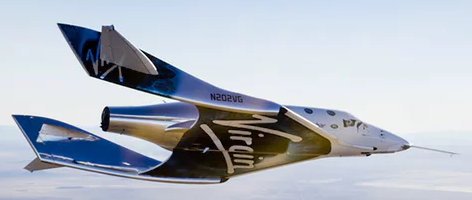 https://www.theguardian.com/science/2016/dec/08/virgin-galactic-tests-new-spaceplane-spacewatch
70 宇宙旅行のコスト 【宇宙旅行】宇宙との対話○貨物 [1]・・・< >:成功率(%)・ファルコン(スペースX/米国) 16億円/t<79.2>・プロトン(ILS/ロシア) 17億円/t<88.2>・H2B(三菱重工業/日本) 18億円/t<100> [2]・H2A(三菱重工業/日本) 21億円/t<96.7> [3]・アリアン(アリアンスペース/欧州) 21億円/t<95.2>○旅客・ソユーズによるISSへの往復 85億円(2013) [4] ・4分間の宇宙旅行(訓練含む) 25万米ドル [5]【参 照】1. 読売新聞 2015年11月25日 2. Wikipedia:H-IIBロケット3. Wikipedia:H-IIAロケット4. 松浦 晋也”ウクライナで“困った”。米ロの宇宙での共依存“at 日経ビジネス onlinehttp://business.nikkeibp.co.jp/article/tech/20140522/265187/?P=25. 宇宙旅行の御案内 クラブツーリズム(ヴァージンギャラクティック社 日本地区公式代理店)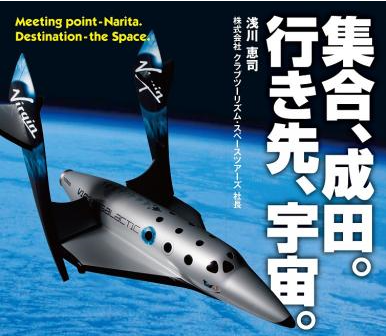 http://www.club-t.com/space/main.htm
68 Fusion Power【Space Travel】Dialogue with the Universe
68-1 ITER( International Thermonuclear Experimental Reactor) [1]
・The goal is to build a fusion power plant in 2040-2050.
・The ITER experimental design has been changed to 2020, one year later than originally planned, under the influence of in eastern earthquake. Aim to start full-scale operation in 2027 as planned. The total project cost is 2 trillion yen.
・In addition, experimental reactor completion of the 2020 has become difficult.
【Reference】
・The name is derived from iter (: Net, Road).
・Seven countries and Region (Japan, China, EU, India, Russia, South Korea, USA)are involved in the this plan.
・ITER construction site is in Cadarache, France.
※Tokamak :A tokamak is a device that uses a toroidal field (traveling around the torus in circles) and a poloidal field (traveling in circles orthogonal to the toroidal field). In a tokamak, the toroidal field is produced by electromagnets that surround the torus, and the poloidal field is the result of a toroidal electric current that flows inside the plasma. This current is induced inside the plasma with a second set of electromagnets. In this device, construction cost is cheap but plasma is unstable. [2]
68-2 Nuclear Fusion Reaction [3]
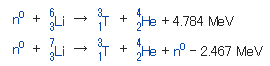
○The most-researched candidate for producing controlled thermonuclear fusion power is D-T fusion reaction. (D: deuterium, T: tritium)
 ○Deuterium is contained in large quantities in seawater.
○Tritium is breeded while irradiated with neutrons in lithium blanket surrounding the fusion reactor.
○Deuterium is contained in large quantities in seawater.
○Tritium is breeded while irradiated with neutrons in lithium blanket surrounding the fusion reactor.
 68-3 Proton-proton chain reaction [4]
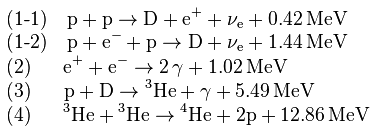
○The proton–proton chain reaction is one of the two (known) sets of fusion reactions by which stars convert hydrogen to helium. It dominates in stars the size of the Sun or smaller.
○Plasma(atomic nuclei and electrons become apart) is confined by gravity.
Individual reaction
68-3 Proton-proton chain reaction [4]
○The proton–proton chain reaction is one of the two (known) sets of fusion reactions by which stars convert hydrogen to helium. It dominates in stars the size of the Sun or smaller.
○Plasma(atomic nuclei and electrons become apart) is confined by gravity.
Individual reaction
 Total
Total
 ・ν is e-neutrino, γ is gamma ray.
・(1-1) occurs at a rate of99.75%( (1-2) :0.25%).
68-4 Merit and Demerit
○Merit : Nuclear fusion reaction is stopped automatically with a little adjustment mistake.
○Demerit:Radioactive waste of the same level as nuclear power plant.
68-5 Cold Fusion [5]
○The research is continuing.
68-6 News
○The Wendelstein 7-X fusion device(W7-X)(Stellarator)at Max Planck Institute for Plasma Physics (IPP) in Greifswald produced its first hydrogen plasma on 3 February 2016.
・Successive extensions are planned until, in about 4 years, discharges lasting 30 minutes.
The practical application of nuclear fusion is expected of around 2025. [6]
・Germany has forged ahead in funding the project, which in the past 20 years has cost €1.06bn.
※Stellarator [7](Helical Device):A stellarator is a device used to confine hot plasma with magnetic fields in order to sustain a controlled nuclear fusion reaction.
The name refers to the possibility of harnessing the power source of the sun, a stellar object.
・ν is e-neutrino, γ is gamma ray.
・(1-1) occurs at a rate of99.75%( (1-2) :0.25%).
68-4 Merit and Demerit
○Merit : Nuclear fusion reaction is stopped automatically with a little adjustment mistake.
○Demerit:Radioactive waste of the same level as nuclear power plant.
68-5 Cold Fusion [5]
○The research is continuing.
68-6 News
○The Wendelstein 7-X fusion device(W7-X)(Stellarator)at Max Planck Institute for Plasma Physics (IPP) in Greifswald produced its first hydrogen plasma on 3 February 2016.
・Successive extensions are planned until, in about 4 years, discharges lasting 30 minutes.
The practical application of nuclear fusion is expected of around 2025. [6]
・Germany has forged ahead in funding the project, which in the past 20 years has cost €1.06bn.
※Stellarator [7](Helical Device):A stellarator is a device used to confine hot plasma with magnetic fields in order to sustain a controlled nuclear fusion reaction.
The name refers to the possibility of harnessing the power source of the sun, a stellar object.
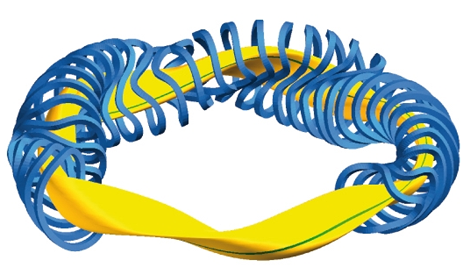 ※ The diameter of the W7-X is 10m. [7]
○A small, modular, efficient fusion plant (Tokamak)
New design could finally help to bring the long-sought power source closer to reality.
August 10, 2015 MIT News [8]
※ The diameter of the W7-X is 10m. [7]
○A small, modular, efficient fusion plant (Tokamak)
New design could finally help to bring the long-sought power source closer to reality.
August 10, 2015 MIT News [8]
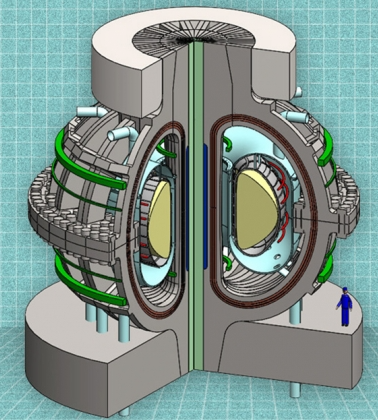 Illustration courtesy of the MIT ARC team [8]
【References】
1. ITER
https://www.iter.org/
2. Wikipedia:Tokamak
3. Wikipedia:Fusion power
4. Wikipedia:Proton-proton chain reaction
5. Wikipedia:Cold Fusion
6. IPP:Max-Planck-Institut für Plasmaphysik
http://www.ipp.mpg.de/4010154/02_16
7. Wikipedia:Stellarator
8. MIT News
http://news.mit.edu/2015/small-modular-efficient-fusion-plant-0810
Illustration courtesy of the MIT ARC team [8]
【References】
1. ITER
https://www.iter.org/
2. Wikipedia:Tokamak
3. Wikipedia:Fusion power
4. Wikipedia:Proton-proton chain reaction
5. Wikipedia:Cold Fusion
6. IPP:Max-Planck-Institut für Plasmaphysik
http://www.ipp.mpg.de/4010154/02_16
7. Wikipedia:Stellarator
8. MIT News
http://news.mit.edu/2015/small-modular-efficient-fusion-plant-0810
67 Colonization of the Planet【Space Travel】Dialogue with the Universe
67-1 Colonization in the solar system
67-1-1 International Space Station (ISS)(1999~2024)) [1]
・Altitude:400 km
・Crew: 6 people
・Weight:420t
・Participating countries:USA, Russia, the European Space Agency, Canada, Japan
・It requires little replenishment of water by also play the water from the urine not only the condensed water in the air. [2]
・Additional crewmembers are transported to the ISS by Soyuz.
・Total cost: 154 billion dollars [2]
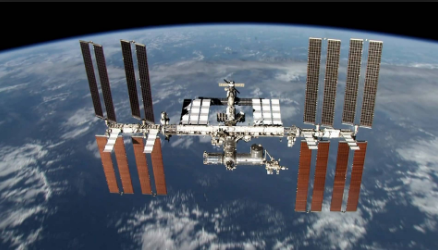 ※ISS [3]
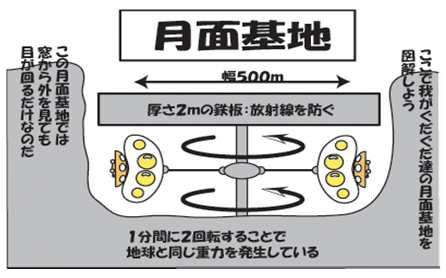
67-1-2 Earth’s Moon
○Google and the X Prize Foundation will hold the moon unmanned exploration race "Google Luna • X Prize (GLXP)"! [4]
・Race participants compete to send high-definition images and videos to the earth until the end 2017.
・Grand Prize $20 million
○About the Moon [5]
・Average distance from Earth: 380,000 km
・Travel time:3 days
・Gravity:1/6 of that found on Earth
・Atmosphere:With too sparse an atmosphere to impede impacts, a steady rain of asteroids, meteoroids and comets strikes the surface of the moon.
・Water:In 2009, orbiting spacecraft discovered water molecules on the moon.
・Oxigen:The crust is made of oxygen, silicon, magnesium, iron, calcium and aluminum, with small amounts of titanium, uranium, thorium, potassium and hydrogen.
・Radiation:It does not provide any protection from the sun's radiation.
・Long ago the moon had active volcanoes, but today they are all dormant and have not erupted for millions of years.
※ISS [3]
67-1-2 Earth’s Moon
○Google and the X Prize Foundation will hold the moon unmanned exploration race "Google Luna • X Prize (GLXP)"! [4]
・Race participants compete to send high-definition images and videos to the earth until the end 2017.
・Grand Prize $20 million
○About the Moon [5]
・Average distance from Earth: 380,000 km
・Travel time:3 days
・Gravity:1/6 of that found on Earth
・Atmosphere:With too sparse an atmosphere to impede impacts, a steady rain of asteroids, meteoroids and comets strikes the surface of the moon.
・Water:In 2009, orbiting spacecraft discovered water molecules on the moon.
・Oxigen:The crust is made of oxygen, silicon, magnesium, iron, calcium and aluminum, with small amounts of titanium, uranium, thorium, potassium and hydrogen.
・Radiation:It does not provide any protection from the sun's radiation.
・Long ago the moon had active volcanoes, but today they are all dormant and have not erupted for millions of years.
 67-1-3 Mars
67-1-3-1 Mars One[6 ][7]
○Mars One aims to create a permanent human colony on Mars in 2027.
○Roadmap
2016 Latest tests will cut candidates down to just 40 - 24 of whom will make the trip
2017 The first teams of candidates are expected to be selected and start training.
2020 A demonstration mission is sent to Mars to test technologies, while a satellite is placed into Martian orbit.
2022 A rover is launched to Mars to find a settlement location.
2024 Mars One sends a second rover, two living units, two life support systems and a supply unit to Mars, to form the habitat.
2027 First humans land on Mars
2028~ Additional 2crews will land every two years.
○Mars One is possible with conventional technology, but funding is a problem.
・Cost: $ 6 billion
(Funds are raised in broadcasting rights and donations.)
(So far, it has raised $ 780,000.)
67-1-3 Mars
67-1-3-1 Mars One[6 ][7]
○Mars One aims to create a permanent human colony on Mars in 2027.
○Roadmap
2016 Latest tests will cut candidates down to just 40 - 24 of whom will make the trip
2017 The first teams of candidates are expected to be selected and start training.
2020 A demonstration mission is sent to Mars to test technologies, while a satellite is placed into Martian orbit.
2022 A rover is launched to Mars to find a settlement location.
2024 Mars One sends a second rover, two living units, two life support systems and a supply unit to Mars, to form the habitat.
2027 First humans land on Mars
2028~ Additional 2crews will land every two years.
○Mars One is possible with conventional technology, but funding is a problem.
・Cost: $ 6 billion
(Funds are raised in broadcasting rights and donations.)
(So far, it has raised $ 780,000.)
 ※Mars One Webshop [7]
67-1-3-2 SpaceX [8]
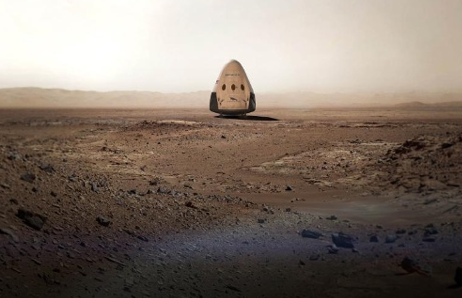
○The SpaceX CEO has unveiled a vision for the colonization of Mars that he says will involve hundreds of reusable craft, each carrying somewhere between 100 and 250 colonists or so and also producing fuel from available resources on Mars for the return trips.
○Roadmap
2018 Unmanned missions could commence.
67-1-3-3 About Mars [9]
・A trip to Mars:6–7 months
・Diameter:half of the Earth
・Gravity:about 40% of the Earth
・Rotation period:24 hours and 40 minutes
・Satellites, two (Deimos, Phobos)
・Air:0.75% of the Earth (95% carbon dioxide, 3% nitrogen, 1.6% argon)
・Water:there is ice in the basement.
・Due to the lack of a magnetosphere, solar particle events and cosmic rays can easily reach the Martian surface.
・Rradiation levels in orbit above Mars are 2.5 times higher than at the International Space Station.
67-1-4 Space elevators
○Now, why do we need space elevators?
○Because transportation cost of space elevator is 1/160 of the rocket.
※Transportation cost of space elevator::5million~10 million$/t(Falcon:1.6billion$/t) [10]
○In 2012, the Obayashi Corporation announced that in 38 years it could build a space elevator using carbon nanotube technology. At 200 kilometers per hour, the design's 30-passenger climber would be able to reach the GEO level after a 7.5 day trip. [10]
○An Earth-based space elevator would consist of a cable with one end attached to the surface near the equator and the other end in space beyond geostationary orbit (35,800 km altitude). [10]
○To construct a space elevator on Earth the cable material would need to be both stronger and lighter. [10]
※ The length of the cable: 144,000km, weight :7,000t
○The estimated construction costs would be $10 billion.
※Mars One Webshop [7]
67-1-3-2 SpaceX [8]
○The SpaceX CEO has unveiled a vision for the colonization of Mars that he says will involve hundreds of reusable craft, each carrying somewhere between 100 and 250 colonists or so and also producing fuel from available resources on Mars for the return trips.
○Roadmap
2018 Unmanned missions could commence.
67-1-3-3 About Mars [9]
・A trip to Mars:6–7 months
・Diameter:half of the Earth
・Gravity:about 40% of the Earth
・Rotation period:24 hours and 40 minutes
・Satellites, two (Deimos, Phobos)
・Air:0.75% of the Earth (95% carbon dioxide, 3% nitrogen, 1.6% argon)
・Water:there is ice in the basement.
・Due to the lack of a magnetosphere, solar particle events and cosmic rays can easily reach the Martian surface.
・Rradiation levels in orbit above Mars are 2.5 times higher than at the International Space Station.
67-1-4 Space elevators
○Now, why do we need space elevators?
○Because transportation cost of space elevator is 1/160 of the rocket.
※Transportation cost of space elevator::5million~10 million$/t(Falcon:1.6billion$/t) [10]
○In 2012, the Obayashi Corporation announced that in 38 years it could build a space elevator using carbon nanotube technology. At 200 kilometers per hour, the design's 30-passenger climber would be able to reach the GEO level after a 7.5 day trip. [10]
○An Earth-based space elevator would consist of a cable with one end attached to the surface near the equator and the other end in space beyond geostationary orbit (35,800 km altitude). [10]
○To construct a space elevator on Earth the cable material would need to be both stronger and lighter. [10]
※ The length of the cable: 144,000km, weight :7,000t
○The estimated construction costs would be $10 billion.
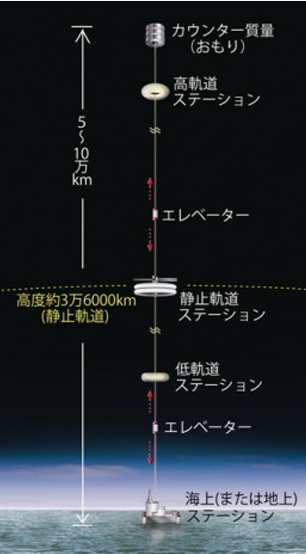 ※宇宙エレベーター [11]
67-2 Alpha Centauri [12]
○Alpha Centauri (α Cen) is the closest star system to the Solar System at 4.37 ly. It consists of three stars
○Mass and Age
・A:1.1M(the mass of the Sun)、4.85 billion years
・B:0.907M、4.85 billion years
・C (Proxima):0.123M、4.85 billion years
○Reaching period:30,000 years
○About 25,000 years later, Alpha Centauri will be 3.26 ly away.
○If you think the energy and safety between the long-term move, it is necessary to utilize the forces of nature.
→No.80 Starship Solar-System(SSS)
67-3
○The Sun lies at a distance of 25,000–28,000 light-years from the Milky Way Galactic Center. The Milky Way is a barred spiral galaxy that has a diameter usually considered to be about 100,000–120,000 light-years
・The Milky Way contains over 200 billion stars.
☆Depending on the movement of neighborhood stars, there is a possibility that the sun is close to the other stars.
※宇宙エレベーター [11]
67-2 Alpha Centauri [12]
○Alpha Centauri (α Cen) is the closest star system to the Solar System at 4.37 ly. It consists of three stars
○Mass and Age
・A:1.1M(the mass of the Sun)、4.85 billion years
・B:0.907M、4.85 billion years
・C (Proxima):0.123M、4.85 billion years
○Reaching period:30,000 years
○About 25,000 years later, Alpha Centauri will be 3.26 ly away.
○If you think the energy and safety between the long-term move, it is necessary to utilize the forces of nature.
→No.80 Starship Solar-System(SSS)
67-3
○The Sun lies at a distance of 25,000–28,000 light-years from the Milky Way Galactic Center. The Milky Way is a barred spiral galaxy that has a diameter usually considered to be about 100,000–120,000 light-years
・The Milky Way contains over 200 billion stars.
☆Depending on the movement of neighborhood stars, there is a possibility that the sun is close to the other stars.
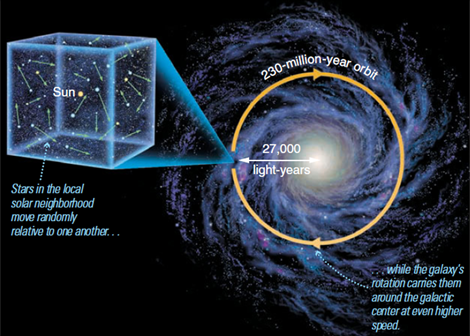 ※The monement of the local solar neighborhood [13]
67-4 Collision with Andromeda Galaxy [14]
○In about four billion years, the Milky Way will collide with its nearest neighbor, the Andromeda Galaxy. The two are rushing towards each other at about 112 km per second.
○After the Collision the two galaxy should settle into a smooth elliptical galaxy.
67-5 News
○A diamond planet was found![15]
・This planet is only 40 light-years away.
・It takes 300,000 years for one way, 600,000 years for round trip by the spacecraft.
☆Hasten the development of the Hayabusa-Z!
【Referendes】
1. Tim Sharp”International Space Station: Facts, History & Tracking“at Space.com 2160405
http://www.space.com/16748-international-space-station.html
2.Wikipedia:国際宇宙ステーション
3.”The International Space Station: Together is the Future” NASA
https://www.youtube.com/watch?v=NtrVwX1ncqk
4. "Google Luna • X Prize (GLXP)"
http://lunar.xprize.org/about/overview
5. Moon: Home - NASA
http://solarsystem.nasa.gov/moon/moonfacts.cfm
6.MARK PRIGG FOR DAILYMAIL.COM “The final countdown for Mars One: 100 remaining candidates for controversial one way trip to undergo 'intense' testing” 20160606
http://www.dailymail.co.uk/sciencetech/article-3628235/The-final-countdown-Mars-One-100-remaining-candidates-controversial-one-way-trip-undergo-intense-testing.html
7. Mars One
http://www.mars-one.com/mission/roadmap
8. Sid Perkins”Elon Musk’s path to Mars begins with Red Dragon—but what science will it do?”at Science 20160927
http://www.sciencemag.org/news/2016/09/elon-musk-s-path-mars-begins-red-dragon-what-science-will-it-do
9. Wikipedia:C olonization of Mars
https://en.wikipedia.org/wiki/Colonization_of_Mars
10. Wikipedia:Space elevator
11. 石井 英男”宇宙エレベーターが実現する「2050年宇宙の旅」” at TELESCOPE Magazine 2013
http://www.tel.co.jp/museum/magazine/spacedev/130603_topics_07/
12.Wikipedia:Alpha Centauri
13. BhavanaJagat
https://bhavanajagat.com/2015/01/01/happy-new-year-the-perception-of-time/
14. Nola Taylor Redd” The Andromeda Galaxy (M31): Location, Characteristics & Images”at SPACE.com 20120508
http://www.space.com/15590-andromeda-galaxy-m31.html
15. Caterina Visco” Il pianeta di diamante”at WIRED 20120812
http://daily.wired.it/news/scienza/2012/10/12/pianeta-diamante-123456.html
※The monement of the local solar neighborhood [13]
67-4 Collision with Andromeda Galaxy [14]
○In about four billion years, the Milky Way will collide with its nearest neighbor, the Andromeda Galaxy. The two are rushing towards each other at about 112 km per second.
○After the Collision the two galaxy should settle into a smooth elliptical galaxy.
67-5 News
○A diamond planet was found![15]
・This planet is only 40 light-years away.
・It takes 300,000 years for one way, 600,000 years for round trip by the spacecraft.
☆Hasten the development of the Hayabusa-Z!
【Referendes】
1. Tim Sharp”International Space Station: Facts, History & Tracking“at Space.com 2160405
http://www.space.com/16748-international-space-station.html
2.Wikipedia:国際宇宙ステーション
3.”The International Space Station: Together is the Future” NASA
https://www.youtube.com/watch?v=NtrVwX1ncqk
4. "Google Luna • X Prize (GLXP)"
http://lunar.xprize.org/about/overview
5. Moon: Home - NASA
http://solarsystem.nasa.gov/moon/moonfacts.cfm
6.MARK PRIGG FOR DAILYMAIL.COM “The final countdown for Mars One: 100 remaining candidates for controversial one way trip to undergo 'intense' testing” 20160606
http://www.dailymail.co.uk/sciencetech/article-3628235/The-final-countdown-Mars-One-100-remaining-candidates-controversial-one-way-trip-undergo-intense-testing.html
7. Mars One
http://www.mars-one.com/mission/roadmap
8. Sid Perkins”Elon Musk’s path to Mars begins with Red Dragon—but what science will it do?”at Science 20160927
http://www.sciencemag.org/news/2016/09/elon-musk-s-path-mars-begins-red-dragon-what-science-will-it-do
9. Wikipedia:C olonization of Mars
https://en.wikipedia.org/wiki/Colonization_of_Mars
10. Wikipedia:Space elevator
11. 石井 英男”宇宙エレベーターが実現する「2050年宇宙の旅」” at TELESCOPE Magazine 2013
http://www.tel.co.jp/museum/magazine/spacedev/130603_topics_07/
12.Wikipedia:Alpha Centauri
13. BhavanaJagat
https://bhavanajagat.com/2015/01/01/happy-new-year-the-perception-of-time/
14. Nola Taylor Redd” The Andromeda Galaxy (M31): Location, Characteristics & Images”at SPACE.com 20120508
http://www.space.com/15590-andromeda-galaxy-m31.html
15. Caterina Visco” Il pianeta di diamante”at WIRED 20120812
http://daily.wired.it/news/scienza/2012/10/12/pianeta-diamante-123456.html